
'%3e%3cpath%20d='M4.02991%2017.5H0.297321V5.81641H4.02991V17.5ZM2.16161%204.22266C0.968304%204.22266%200%203.26172%200%202.10156C0%201.54297%200.229018%201.01172%200.634821%200.617188C1.04062%200.222656%201.59107%200%202.16161%200C2.73214%200%203.28259%200.222656%203.68839%200.617188C4.0942%201.01172%204.32321%201.54688%204.32321%202.10156C4.32321%203.26172%203.35491%204.22266%202.16161%204.22266ZM17.996%2017.5H14.2714V11.8125C14.2714%2010.457%2014.2433%208.71875%2012.3308%208.71875C10.3902%208.71875%2010.0929%2010.1914%2010.0929%2011.7148V17.5H6.36429V5.81641H9.9442V7.41016H9.99643C10.4946%206.49219%2011.7121%205.52344%2013.5281%205.52344C17.3049%205.52344%2018%207.94141%2018%2011.082V17.5H17.996Z'%20fill='white'%20/%3e%3c/g%3e%3cdefs%3e%3cclipPath%20id='clip0_1338_1747'%3e%3crect%20width='18'%20height='20'%20fill='white'%20/%3e%3c/clipPath%3e%3c/defs%3e%3c/svg%3e)

'%3e%3cpath%20d='M14.3517%201.875H17.1883L10.9928%208.75781L18.2812%2018.125H12.5758L8.10396%2012.4453L2.99325%2018.125H0.152623L6.77807%2010.7617L-0.208984%201.875H5.64102L9.67896%207.06641L14.3517%201.875ZM13.3553%2016.4766H14.9263L4.78521%203.4375H3.09771L13.3553%2016.4766Z'%20fill='white'%20/%3e%3c/g%3e%3cdefs%3e%3cclipPath%20id='clip0_1338_1751'%3e%3crect%20width='18'%20height='20'%20fill='white'%20/%3e%3c/clipPath%3e%3c/defs%3e%3c/svg%3e)


TL;DR
-
PostgreSQL is an object-relational database built for complex queries, high write volumes, and strict data integrity, while MySQL is a purely relational database optimized for fast, read-heavy workloads.
-
Both support MVCC for concurrency, but PostgreSQL implements it natively, while MySQL relies on the InnoDB storage engine.
-
PostgreSQL offers richer data types and indexing, including JSONB, arrays, GIN, and GiST indexes, whereas MySQL covers most web application needs with standard B-tree, full-text, and spatial indexes.
-
Choose PostgreSQL for financial systems, analytics, geospatial data, or complex data models; choose MySQL for content management systems, e-commerce, and straightforward, read-heavy web applications.
-
Licensing differs too: PostgreSQL uses a permissive, MIT-like license with no restrictions on commercial use, while MySQL's GPL license can impose obligations on derivative works unless you buy a commercial license.
Choosing the right open source relational database is one of the most critical decisions for any application. Both PostgreSQL and MySQL are powerful, popular, and proven in production, but they excel in different areas. This comparison provides the technical details you need to select the best database for your project's specific requirements.
At a Glance
- Architecture: PostgreSQL is an object-relational database (ORDBMS), offering more complex data types and features. MySQL is a pure relational database (RDBMS), prized for its simplicity and speed.
- Performance: PostgreSQL excels at complex queries and high-volume write operations due to its MVCC implementation. MySQL is renowned for its high performance in read-heavy scenarios.
- SQL Compliance: PostgreSQL adheres very closely to SQL standards, ensuring high compatibility. MySQL is also highly compliant but includes some non-standard extensions.
- Use Cases: Use PostgreSQL for analytics, geospatial services, and systems requiring high data integrity. Use MySQL for content management systems, e-commerce platforms, and read-intensive web applications.
What is PostgreSQL?
PostgreSQL is an advanced open source object-relational database management system (ORDBMS). Its key strengths are strict standards compliance, reliability, and a rich feature set that includes advanced data types and high extensibility. Often called "Postgres," it handles complex queries and large data volumes with exceptional data integrity, making it a preferred choice for data warehousing, analytics, and critical transactional systems.
What is MySQL?
MySQL is the world's most popular open source relational database management system (RDBMS). It is known for its speed, reliability, and ease of use. Its architecture, particularly with the InnoDB storage engine, is highly optimized for the read-heavy workloads common in web applications, content management systems (like WordPress and Drupal), and e-commerce platforms.
PostgreSQL vs. MySQL: A Head-to-Head Comparison
| Feature | PostgreSQL | MySQL |
|---|---|---|
| Architecture | Object-Relational (ORDBMS) | Purely Relational (RDBMS) |
| SQL Compliance | Very high, closely follows SQL standards | High, with some proprietary extensions |
| Concurrency | Native Multi-Version Concurrency Control (MVCC) | MVCC via InnoDB Storage Engine |
| Indexing | Advanced types: Partial, Expression, GIN, GiST | Standard types: B-Tree, Full-text, Spatial |
| Data Types | Rich & extensible: JSONB, GIS, Arrays, hstore | Standard types with robust JSON support |
| Extensibility | Highly extensible with custom functions & types | Less extensible, focused on core performance |
| Licensing | PostgreSQL License (Permissive, MIT-like) | GNU GPL v2 / Proprietary Commercial |
Key Differences: PostgreSQL vs. MySQL
While both are ACID-compliant relational databases, their underlying architectures lead to significant differences in functionality and performance.
1. Architecture: Object-Relational vs. Relational
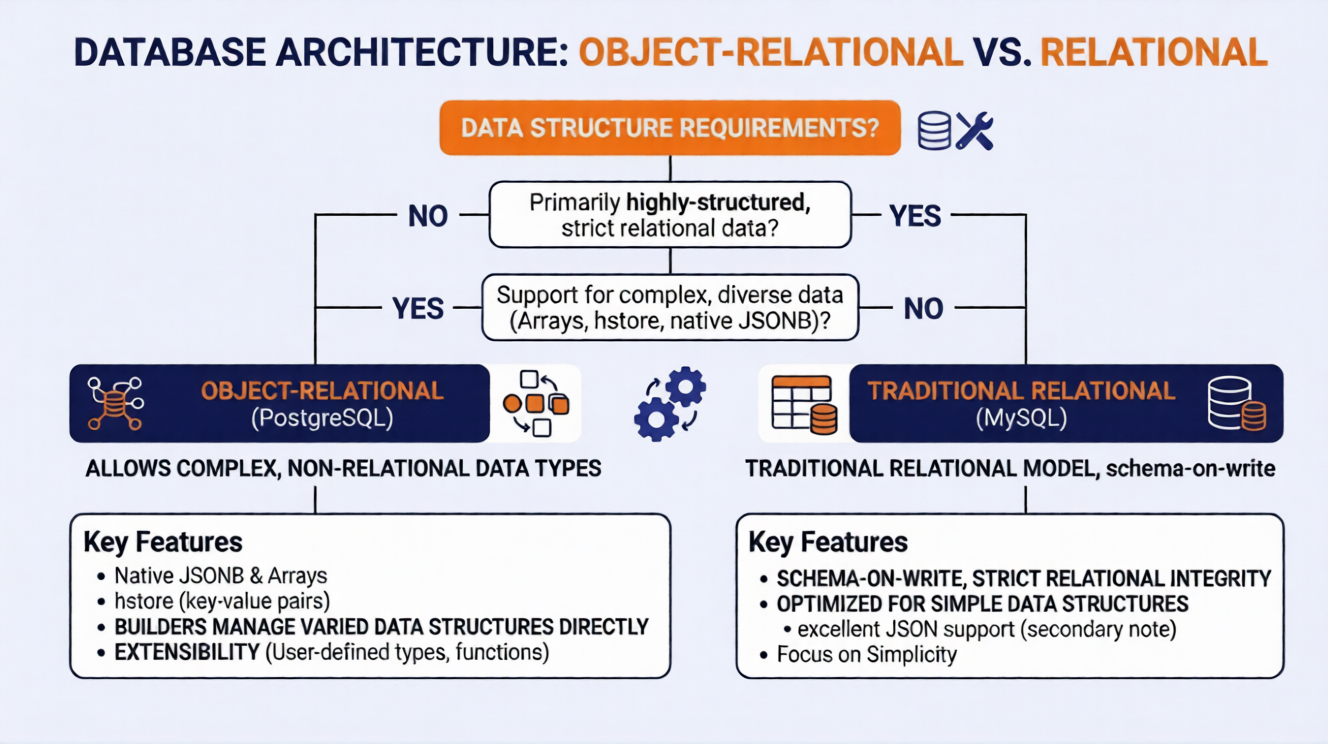
PostgreSQL's object-relational model allows it to support complex, non-relational data types like arrays, hstore (key-value pairs), and native JSONB. This enables builders to manage more varied data structures directly within the database.
MySQL follows a more traditional relational model, which enforces a stricter schema-on-write approach. While it has excellent JSON support, its core design prioritizes simplicity and relational integrity.
2. Concurrency Control
Concurrency determines how the database handles multiple simultaneous operations. PostgreSQL implements Multi-Version Concurrency Control (MVCC) at its core. This means that readers never block writers, and writers never block readers, providing excellent performance in mixed-use workloads with high transaction volumes.
MySQL also achieves MVCC when you use its default InnoDB storage engine. However, because it's part of the storage engine rather than the core database, its behavior can differ from PostgreSQL's native implementation.
3. Indexing Capabilities
Both databases use B-tree indexing as the default, but PostgreSQL offers a wider array of specialized index types:
- Generalized Inverted Index (GIN): Optimizes searches on composite values like arrays or JSONB documents.
- Generalized Search Tree (GiST): Useful for indexing geometric data and full-text search.
- Partial Indexes: Allow you to index only a subset of rows in a table, saving space and improving performance for specific queries.
MySQL provides robust standard indexing, including full-text and spatial indexes, which cover the majority of web application use cases effectively.
4. Data Types and JSON Support
PostgreSQL offers one of the richest sets of native data types, including network addresses, geometric shapes, and native UUIDs. Its binary JSON format, JSONB, is a key differentiator. It stores JSON data in an optimized binary format that you can index, leading to much faster query performance compared to storing JSON as plain text.
MySQL has a native JSON data type that stores JSON as text. It provides a robust set of functions for document validation and manipulation, making it a strong choice for applications that need to store and query JSON documents.
5. Licensing and Governance
This is a critical business consideration. The PostgreSQL Global Development Group, a diverse community of contributors, governs PostgreSQL. It uses the permissive PostgreSQL License, which is similar to the MIT license and places no restrictions on how you use, modify, or distribute the software.
Oracle Corporation owns and develops MySQL. It offers a free community edition under the GNU General Public License (GPL) and a commercial edition with proprietary features and support. The GPL license requires that derivative works also be open source, which can have implications for commercial applications.
How to Choose: A Practical Framework
Your choice depends entirely on your application's specific needs. Use this framework to make a confident decision.
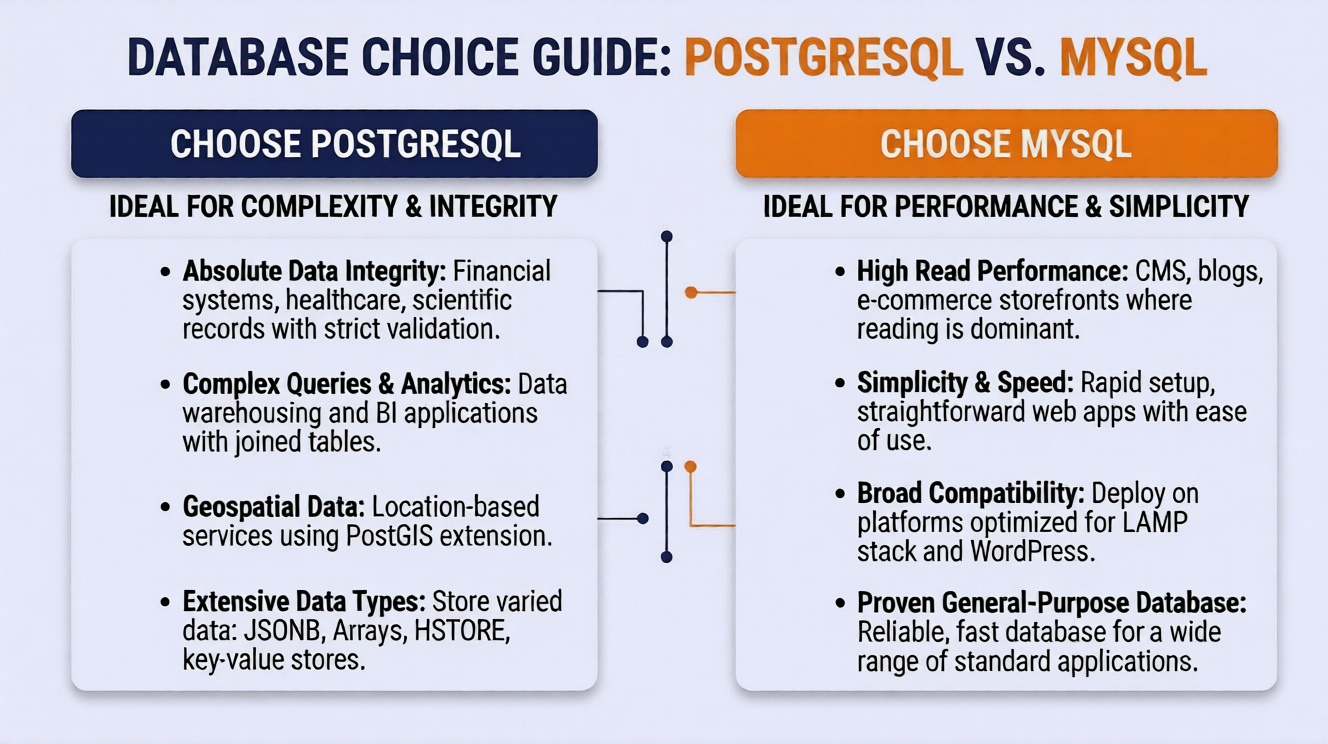
Choose PostgreSQL if you need:
- Absolute Data Integrity: For financial systems, healthcare records, or scientific research where strict data validation is non-negotiable.
- Complex Queries and Analytics: For data warehousing or business intelligence applications that run complex joins and aggregations.
- Geospatial Data: For location-based services, using the powerful PostGIS extension.
- Extensive Data Types: When you need to store varied data like arrays, key-value stores, or nested JSON documents within a relational structure.
Choose MySQL if you need:
- High Read Performance: For content management systems, blogs, or e-commerce storefronts where read operations far outnumber writes.
- Simplicity and Speed: For straightforward web applications where rapid setup and ease of use are priorities.
- Broad Compatibility: When deploying on platforms that are heavily optimized for the LAMP (Linux, Apache, MySQL, PHP) stack, like WordPress.
- A Proven General-Purpose Database: For a reliable, fast, and well-understood database for a wide range of standard applications.
Simplify Your Database Management with Aiven
Regardless of your choice, managing a database at scale involves complexity, from configuration and backups to scaling and security. The Aiven platform automates this operational overhead for both PostgreSQL and MySQL.
With Aiven for PostgreSQL® and Aiven for MySQL®, you can deploy a production-ready database in minutes. We handle the maintenance, so your builders can focus on creating value, not managing infrastructure. Explore our managed database solutions to accelerate your next project.
Frequently Asked Questions (FAQ)
Which database is faster, PostgreSQL or MySQL?
There is no single answer. MySQL is typically faster for read-heavy workloads, while PostgreSQL often performs better with complex queries, high write volumes, and mixed read/write scenarios due to its robust MVCC implementation.
Is PostgreSQL more secure than MySQL?
Both databases are very secure and offer strong security features. They both use Transport Layer Security (TLS/SSL) to encrypt data in transit and provide robust role-based access control systems. Security depends more on proper configuration and management than on the database itself.
Can I migrate from MySQL to PostgreSQL?
Yes, migration is possible, but it requires careful planning. Tools exist to help with the process, but you must account for differences in data types, SQL syntax (like AUTO_INCREMENT vs. SERIAL), and stored procedures. A managed platform like Aiven can simplify the migration process by handling the setup and configuration of the target database.
Which database scales better: PostgreSQL or MySQL?
Both scale well, but in different ways.
-
MySQL is often easier to scale horizontally for read-heavy workloads using replicas.
-
PostgreSQL scales extremely well vertically and is well-suited for complex workloads; horizontal scaling is typically achieved using extensions, sharding tools, or managed services.
In practice, the scalability differences matter less when using a managed database platform that abstracts replication and scaling.
Can PostgreSQL replace MySQL for a typical web application?
Yes, absolutely. PostgreSQL works very well for most web applications and is widely used for APIs, SaaS platforms, and content-driven sites. However, if your application is tightly coupled to MySQL-specific features or tools (for example, certain CMS plugins), migrating may require additional effort.
How do PostgreSQL and MySQL compare for JSON data?
Both support JSON, but with important differences:
-
PostgreSQL offers
JSONB, a binary format that supports indexing and efficient querying, making it ideal for hybrid relational/document workloads. -
MySQL provides a native JSON type stored as text with strong validation and manipulation functions.
If JSON is central to your data model and queried frequently, PostgreSQL generally offers more flexibility and performance.
Which database is better for transactions and data integrity?
PostgreSQL is often preferred for systems where data integrity is critical, such as financial applications or systems with complex constraints. It enforces stricter standards compliance and offers more advanced constraint types.
MySQL is also ACID-compliant (with InnoDB) and is perfectly safe for most transactional workloads, but PostgreSQL’s defaults are generally more conservative and standards-driven.
Is MySQL easier to learn than PostgreSQL?
For many developers, yes. MySQL’s simpler feature set and long-standing presence in the LAMP stack make it approachable for beginners.
PostgreSQL has a steeper learning curve due to its rich feature set, but that complexity pays off as applications grow in sophistication.
What about full-text search - PostgreSQL or MySQL?
Both databases support full-text search:
-
PostgreSQL provides powerful full-text search capabilities with ranking, dictionaries, and language support.
-
MySQL includes built-in full-text indexes that are easy to use and sufficient for many applications.
For advanced search use cases, PostgreSQL is often more flexible, while MySQL offers simplicity for basic needs.
Does licensing affect my choice between PostgreSQL and MySQL?
It can.
-
PostgreSQL’s permissive license allows unrestricted commercial use, modification, and distribution.
-
MySQL’s GPL license can impose obligations if you distribute derivative works, unless you use a commercial license.
For businesses building proprietary software, PostgreSQL’s license is often simpler from a legal perspective.
Can I migrate easily between MySQL and PostgreSQL?
Migration is possible, but it’s not trivial. Differences in SQL dialects, data types, indexing, and stored procedures require careful planning and testing. Schema conversion tools and managed services can help, but expect some manual work for non-trivial applications.
Which database should I choose if I’m unsure?
If you’re undecided:
-
Choose PostgreSQL if you expect complex queries, evolving data models, or strong consistency requirements.
-
Choose MySQL if you want a simple, fast, and widely supported database for a read-heavy web application.
When using a managed service like Aiven, you can focus less on operational concerns and more on picking the database that best fits your application’s behavior.
Next steps
Your next step could be to check out Aiven for PostgreSQL and Aiven for MySQL.
If you're not using Aiven services yet, go ahead and sign up now for your free trial at https://console.aiven.io/signup!
In the meantime, make sure you follow our changelog and blog RSS feeds or our LinkedIn and Twitter accounts to stay up-to-date with product and feature-related news.
Further reading

Table of contents
- At a Glance
- What is PostgreSQL?
- What is MySQL?
- PostgreSQL vs. MySQL: A Head-to-Head Comparison
- Key Differences: PostgreSQL vs. MySQL
- 1. Architecture: Object-Relational vs. Relational
- 2. Concurrency Control
- 3. Indexing Capabilities
- 4. Data Types and JSON Support
- 5. Licensing and Governance
- How to Choose: A Practical Framework
- Simplify Your Database Management with Aiven
- Frequently Asked Questions (FAQ)
- Which database is faster, PostgreSQL or MySQL?
- Is PostgreSQL more secure than MySQL?
- Can I migrate from MySQL to PostgreSQL?
- Which database scales better: PostgreSQL or MySQL?
- Can PostgreSQL replace MySQL for a typical web application?
- How do PostgreSQL and MySQL compare for JSON data?
- Which database is better for transactions and data integrity?
- Is MySQL easier to learn than PostgreSQL?
- What about full-text search - PostgreSQL or MySQL?
- Does licensing affect my choice between PostgreSQL and MySQL?
- Can I migrate easily between MySQL and PostgreSQL?
- Which database should I choose if I’m unsure?
- Next steps
- Further reading