Aiven delivers for Wolt’s business
Wolt achieves major savings by using Aiven's managed data infrastructure. Find out how they are utilizing open source tools in the delivery technology space.
The overview
Wolt is a local commerce company founded in 2014 in Helsinki, Finland and operating in 23 countries and 250+ cities around the world, serving millions of customers. Their mission is to save people’s time by making it easy to discover and get whatever they want brought straight to them, and to make cities better places to live. But Wolt is much, much more than just another delivery service. They are a technology company at heart, with their own robust, flexible and scalable platform for offering, ordering and delivering goods and services.
Highlights
- Wolt offers their technology and services in 23 countries with Aiven for Apache Kafka® and Aiven for OpenSearch.
- Large cost savings and improved business focus through use of managed services.
- Using Apache Kafka avoids having to manage and scale hard-coded relationships between services.
- Tool support and scalability contribute to ease of use.
"When you don’t have to worry about a service being down, you can concentrate on your own business."
Jacopo Chiapparino
Head of Engineering, Data
The challenge
From the very beginning, Wolt knew that their platform and technology would make or break their business. Technology would be the foundation for all their business goals and growth, and that meant it had to be high quality, stable, and scalable.
“One of the key enablers for us to compete successfully in the delivery space is the fact that Wolt has been investing heavily in the platform and the technology,” says Mikko Peltola, Head of Infrastructure at Wolt. “We’ve invested in building a platform that supports quick expansion and growth for our business.”
The key factor was to find a technology supplier that offered enough flexibility and a complete enough feature set to support growth. At the same time, the solution had to be easy to set up and use. But the overarching concern was that whoever they went with, the service had to be reliable. “When you don’t have to worry about a service being down, you can concentrate on your own business,” says Jacopo Chiapparino, Wolt's Head of Engineering, Data.
Wolt has several good uses for the data that their services generate. Self-evidently, they need to handle that data to provide the actual service, complete the transactions, provide logistics and so on. This is all integral to the consumer experience of ordering goods and waiting for the delivery, and the courier experience of looking for the delivery destination.
But there’s more to the story. Data is also analyzed to provide direction for operational improvement and product development.
“Data drives our decisions,” Jacopo says. This is why it’s important for Wolt to store and manipulate large amounts of data.
Wolt’s old technical solution was based on Redis. Redis lacked the features to build a reliable messaging backbone, such as delivery semantics, guaranteed message delivery and message persistence.
Besides, Wolt was already having difficulty with moving data from their services into their data warehouse. Their solution at the time mostly relied on batch ingestions from endpoints. This didn’t scale well, as it continuously required the development of new endpoints and integrations by the product teams.
In 2018, when scaling up became a critical next step, Wolt immediately saw dark clouds on the horizon.
"One of the key enablers for us to compete successfully in the delivery space is the fact that Wolt has been investing heavily in the platform and the technology"
Mikko Peltola
Head of Infrastructure at Wolt
The solution
With the goal of building long-term and future-proof solutions, the choice to use Apache Kafka® was easy. Apache Kafka® is an industry standard that many Wolt engineers had used in production in their previous workplaces.
Peltola says they always wanted a managed service. Building their own Apache Kafka® architecture and managing it themselves would have been quite expensive. They had 50 engineers on the payroll at the time; the resources needed to manage an in-house Apache Kafka solution would have meant a significant shift away from developing their products and services.
Risk management was another major reason why Wolt didn’t even consider self-managing. With the uptime guarantees given by a managed solution, the risk to their business in case of system failure would be virtually non-existent.
So Wolt started investigating cloud solutions, and in March 2019, they found what they were looking for.
They came across Aiven, and were impressed with the rich feature set and comprehensive tooling. With Aiven, they got a fully managed solution for Apache Kafka® with a 99.99% uptime guarantee. Aiven’s architecture also makes it easy to scale up (or down) as required, which gave Wolt’s business the freedom to expand.
Another feature of Aiven’s that was critical for Wolt was ease of use. Jacopo explains that when introducing a new tool to an organization, learning to use it is the first hurdle to cross. In order to stay productive and to ensure that existing processes continue smoothly, the transition to new tools needs to be seamless.
“When it came to maturity, tool support and interoperability, Aiven was clearly superior to the other providers we looked at,” Peltola says.
Aiven for Wolt
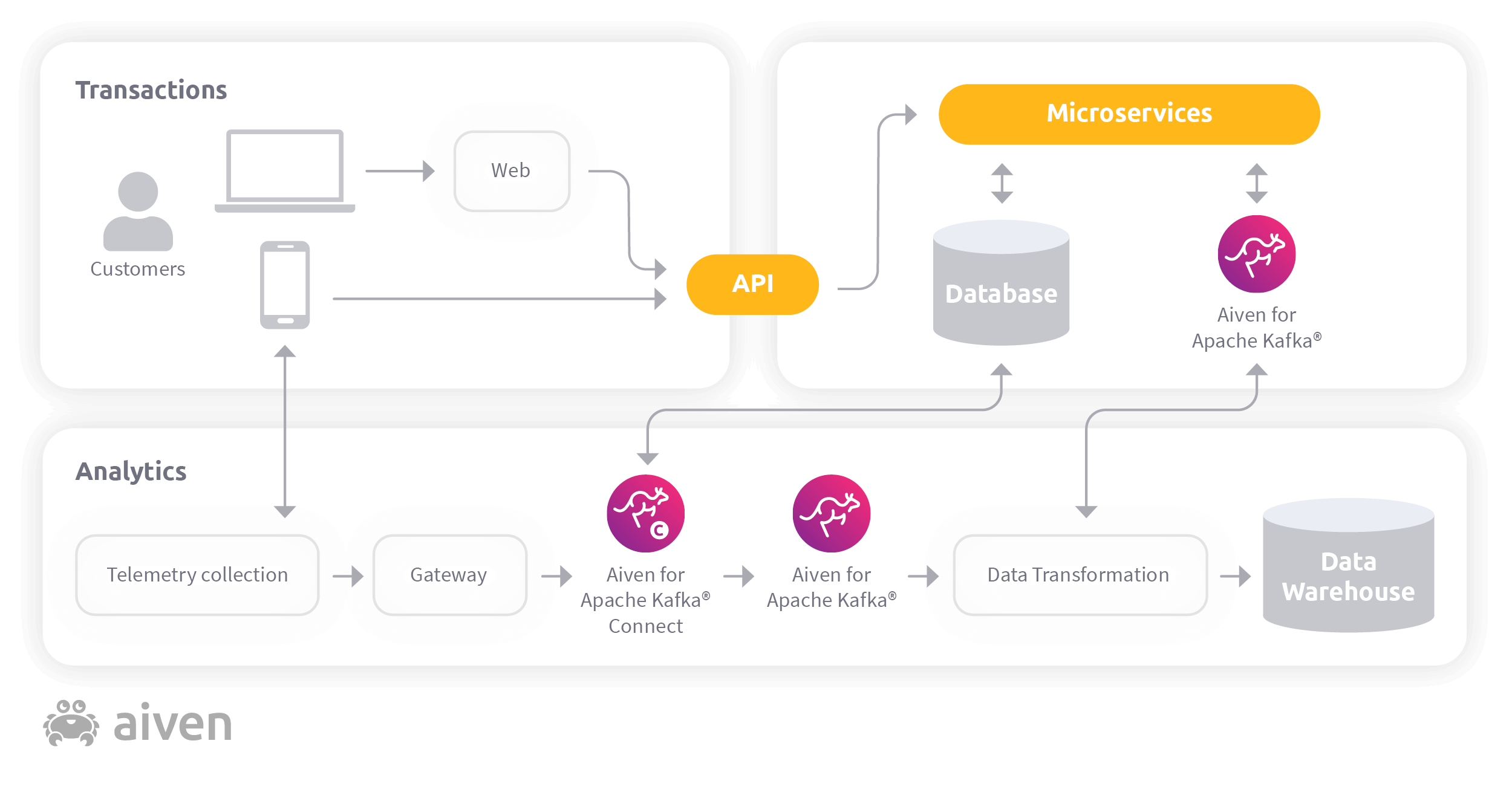
At Wolt, Apache Kafka® is used both as a data broker and as an interservice communication tool. Data moves flexibly into permanent storage. The storage is not static, it can expand and become more granular without the team having to keep building endpoints and integrations.
According to Peltola, there are two main uses for Apache Kafka® at Wolt:
- Apache Kafka® acts as a “message bus” between services. This avoids having to manage and scale hard-coded relationships between services. It’s also a convenient way for services to interact with databases.
- Apache Kafka® ingests data from databases and makes it available for data warehousing tools.
The outcome
Currently Aiven hosts all of Wolt’s Apache Kafka services. During their time with Aiven, Wolt has expanded their business significantly without stretching their in-house teams to breaking point. They are looking into using Apache Kafka® even more extensively, and are preparing to move all of their architecture over at some point. Any new Apache Kafka® instances are spun up with Aiven.
Wolt has found Aiven to be a reliable platform and they know they can trust it to stay up and do its job.
“I am so happy with the level of engineering at Aiven, knowledgeable tech support, tech account managers, and people we meet from Aiven,” says Tatiana Koroleva, Wolt’s DevOps guru. “They’re always ready to research and fix things and go an extra mile to help with integrations.”
Wolt also uses Aiven for OpenSearch for the search functionality in the Wolt mobile application. So whenever a user enters a search query, it’s not just Wolt who answers, it’s also Aiven!
With Aiven, Wolt’s platform teams can focus on development work, not maintenance. “We have about five people working with staging, versus a hundred people working in platform development,” says Jacopo.
Wolt is very happy with its decision to go with Aiven for Apache Kafka®. “Kafka is a complex product and it can easily consume a lot of admin time just to keep it healthy,” says Peltola. “Managing, developing and scaling Kafka in-house is just like any other critical high volume system: it takes a lot of skill, time, research, care and vision to get it right. Managed Kafka has freed a lot of time for our teams to spend on things that add value. We’re talking about major savings here.”
Wolt has a substantial presence in the delivery market, especially in its native Finland. The startup claims more than 10 million users in 23 countries to whom it delivers orders with the help of more than 100,000 courier partners and tens of thousands of restaurant and retail partners. Aiven has been an integral enabler of that growth.
"We’re talking about major savings here."
Mikko Peltola
Head of Infrastructure at Wolt
Related case studies
- Loading...
- Loading...
- Loading...
Get your first cluster online now
Aiven makes setting up cloud databases so simple anyone can do it. Our set-it-and-forget-it solutions take the pain out of cloud data infrastructure.