
'%3e%3cpath%20d='M4.02991%2017.5H0.297321V5.81641H4.02991V17.5ZM2.16161%204.22266C0.968304%204.22266%200%203.26172%200%202.10156C0%201.54297%200.229018%201.01172%200.634821%200.617188C1.04062%200.222656%201.59107%200%202.16161%200C2.73214%200%203.28259%200.222656%203.68839%200.617188C4.0942%201.01172%204.32321%201.54688%204.32321%202.10156C4.32321%203.26172%203.35491%204.22266%202.16161%204.22266ZM17.996%2017.5H14.2714V11.8125C14.2714%2010.457%2014.2433%208.71875%2012.3308%208.71875C10.3902%208.71875%2010.0929%2010.1914%2010.0929%2011.7148V17.5H6.36429V5.81641H9.9442V7.41016H9.99643C10.4946%206.49219%2011.7121%205.52344%2013.5281%205.52344C17.3049%205.52344%2018%207.94141%2018%2011.082V17.5H17.996Z'%20fill='white'%20/%3e%3c/g%3e%3cdefs%3e%3cclipPath%20id='clip0_1338_1747'%3e%3crect%20width='18'%20height='20'%20fill='white'%20/%3e%3c/clipPath%3e%3c/defs%3e%3c/svg%3e)

'%3e%3cpath%20d='M14.3517%201.875H17.1883L10.9928%208.75781L18.2812%2018.125H12.5758L8.10396%2012.4453L2.99325%2018.125H0.152623L6.77807%2010.7617L-0.208984%201.875H5.64102L9.67896%207.06641L14.3517%201.875ZM13.3553%2016.4766H14.9263L4.78521%203.4375H3.09771L13.3553%2016.4766Z'%20fill='white'%20/%3e%3c/g%3e%3cdefs%3e%3cclipPath%20id='clip0_1338_1751'%3e%3crect%20width='18'%20height='20'%20fill='white'%20/%3e%3c/clipPath%3e%3c/defs%3e%3c/svg%3e)


Set aside the data masking features of PostgreSQL Anonymizer. This plugin can save the day during development by simplifying your workflow and generating schema-accurate, privacy-compliant test data.
In a previous post, we discussed using static and dynamic masking to anonymize data.
I spent the last two weeks trying to write followups for the anonymization posts.
It's time to confess... I'm an over-engineerer. When I need to make a demo environment, I tend to go overboard and engineer a proof of concept that could be vibe-coded into your next startup idea.
With each attempted post, I used PostgreSQL Anonymizer to generate thousands of rows of fake data.
What I learned is this extension, great for masking data, is also fantastic at generating synthetic data from nothing.
It's better to not link to real data
When creating a development or staging environment, you usually don't need the real data. In fact, I would argue that the principle of least privilege (POLP) would require you don't use real data. Unless you change all the data, you can still connect information back to create a profile of actual customers. With just the schema you can generate the fake data. This allows you to develop realistic examples that fit your architecture.
Creating Fake Data and Building Examples
Let's build out a test environment for a school grading system.
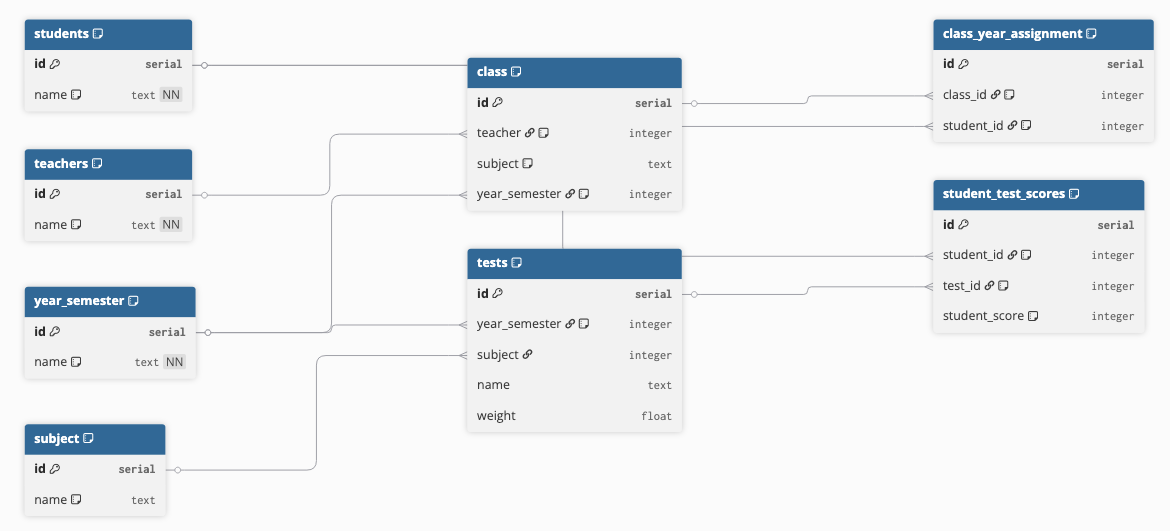
My over-engineered example had tables and relationships for students, teachers, the year and semester, as well as classes and subjects, the class assignments, and the student test scores. This developed over time with each pause and the "Well, if I do X, I'll need Y" that easily scope-creeps its way into designs.
Here is a diagram of the setup I originally designed:
That's a lot. Let's simplify to a single teacher's class. This would be common for a developer only focused on a particular part of the platform. We can limit ourselves at this point to students, tests, and the student_test_scores of a particular class.
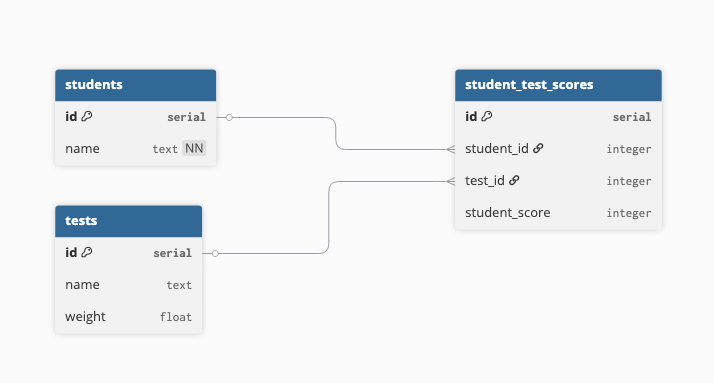
Perfect, the only thing we're missing in this schema design from the main is the year_semester. This information has no effect on what we'd be developing. Now, let's create this simpler design in a testing database.
Loading code...
It's important to know that version 2 of PostgreSQL Anonymizer was completely rewritten in Rust. This means that we're able to create countless options ridiculously faster than the previous version which was written in C. In the example below we're generating data for 30 students, but in previous attempts to build a logistic portal for students selling chocolate, I generated 20,000 students in less than a second.
To create names for this we are going to use a dummy_* function. PostgreSQL Anonymizer creates random-but-plausible values. There are over 70 dummy functions that allow you to replace things like names, email address, phone_numbers and more. There are also some localizations for English and French.
We load the engine containing this functions with select anon.init(). When masking data we would utilize the function in a SECURITY LABEL but with generating fake data we will use it with a generate series function. Since our data model just uses name (and not first/last name) we will generate a complete name with the dummy_name() function.
Loading code...
We'll also make some tests for our students to take. We will weigh the tests similarly to what a high-school or college class may do. We'll call these tests "test-1, test-2, etc". Though if we had a list of topics we could use anon.random_in(ARRAY['LIST','OF','TOPICS']).
Loading code...
Now we need to populate the tests for each student.
Activate over-engineering mode
The simple idea is to generate the first 8 tests at random between 50 - 100. I wanted most students to pass so there is only a 10% chance of failing a test.
The midterms would be based on the average of tests 1-4 with a deviation of about 10%. The final would be the same but using tests 5-8 and the midterm.
Generating numbers in a range
Loading code...
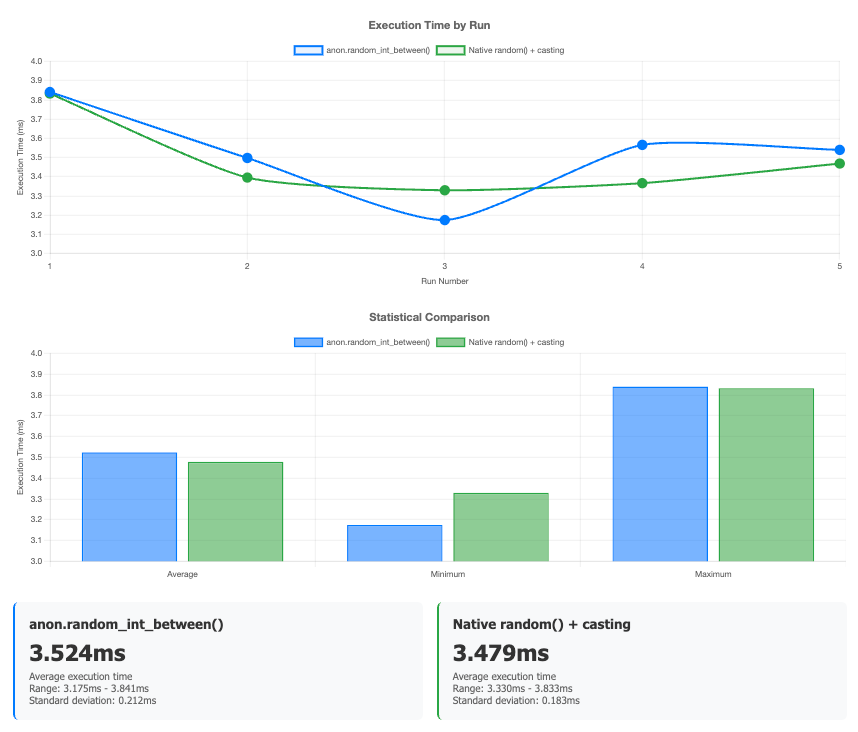
That function anon.random_int_in_range() is much more understandable than the 50 + random() * 19::INTEGER. I also analyzed the two commands running the commands 5 times, clearing the cache between each run. While the anon calls are usually slower, the difference is negligible, arguably even at scale.
Adding noise
Now we need to generate the calculation of the midterms and finals as well. Let's do the midterm tests. We can use AVG and get the average of the tests. Then we need to add some noise to the average. We can use anon.noise() to accomplish this.
Noise generation is used to add variance to a value. You provide the original value and the percentage noise to add. We will standardize the noise to 10%. That means with an average of 80 your new value would be between 72 and 88.
Loading code...
We'll do the same for the final exam based on tests 5-8 plus the midterm:
Loading code...
If we were making a web application or we needed to give this data to some other platform we could export these results into CSV, or some other data.
We could also create a materialized view based on all the tests of the teachers.
Finally, we can then create a materialized view that shows the final scores.
Loading code...
What I learned from over-engineering
So what started as a simple example turned into complex data generation that models realistic student performance patterns. This is exactly the kind of over-engineering I was trying to avoid, but it taught me something important: PostgreSQL Anonymizer isn't just good at masking existing data--it excels at creating realistic synthetic datasets from scratch.
Also as I mentioned in the previous post, much of this work is to make sure that I can use tools like large language models (LLMs) to receive coding help. Using anon.dummy_name() quickly created our users out of thin air. The anon.random_int_in_range() gave us the ability to create realistic test scores. Lastly, the anon.noise() function created midterms and finals scores that reflected the knowledge from previous tests as well as a boost or boon to simulate studying habits. PostgreSQL Anonymizer, powered by Rust, made our code simpler, more effective without sacrificing performance.
This only scratches the surface as there are many other ways to generate partial and completely synthetic data PostgreSQL Anonymizer.
The real lesson
My failed experiments weren't really failures. With my attempt to build a school fundraiser program, I was able to generate thousands of schools with a formula of
Loading code...
and create sales simulations across multiple flavors of chocolate. In my logging example, I made thousands of logs spanning across a day using the anon.dnoise() which is the same as anon.noise(), but allows for datetimes and variations of time intervals.
The principle of least privilege applies here: if you can develop and test with completely synthetic but fitting data that has no connection to real customers, why take the privacy risk of using masked production data at all?
Next time you're setting up a development environment, consider generating your test data rather than copying and masking production data. Your privacy team will thank you, and you might discover that synthetic data gives you more control over testing edge cases than real data ever could.
Plus, you'll have a lot more fun building it, even if you do end up over-engineering it like I did.
