
'%3e%3cpath%20d='M4.02991%2017.5H0.297321V5.81641H4.02991V17.5ZM2.16161%204.22266C0.968304%204.22266%200%203.26172%200%202.10156C0%201.54297%200.229018%201.01172%200.634821%200.617188C1.04062%200.222656%201.59107%200%202.16161%200C2.73214%200%203.28259%200.222656%203.68839%200.617188C4.0942%201.01172%204.32321%201.54688%204.32321%202.10156C4.32321%203.26172%203.35491%204.22266%202.16161%204.22266ZM17.996%2017.5H14.2714V11.8125C14.2714%2010.457%2014.2433%208.71875%2012.3308%208.71875C10.3902%208.71875%2010.0929%2010.1914%2010.0929%2011.7148V17.5H6.36429V5.81641H9.9442V7.41016H9.99643C10.4946%206.49219%2011.7121%205.52344%2013.5281%205.52344C17.3049%205.52344%2018%207.94141%2018%2011.082V17.5H17.996Z'%20fill='white'%20/%3e%3c/g%3e%3cdefs%3e%3cclipPath%20id='clip0_1338_1747'%3e%3crect%20width='18'%20height='20'%20fill='white'%20/%3e%3c/clipPath%3e%3c/defs%3e%3c/svg%3e)

'%3e%3cpath%20d='M14.3517%201.875H17.1883L10.9928%208.75781L18.2812%2018.125H12.5758L8.10396%2012.4453L2.99325%2018.125H0.152623L6.77807%2010.7617L-0.208984%201.875H5.64102L9.67896%207.06641L14.3517%201.875ZM13.3553%2016.4766H14.9263L4.78521%203.4375H3.09771L13.3553%2016.4766Z'%20fill='white'%20/%3e%3c/g%3e%3cdefs%3e%3cclipPath%20id='clip0_1338_1751'%3e%3crect%20width='18'%20height='20'%20fill='white'%20/%3e%3c/clipPath%3e%3c/defs%3e%3c/svg%3e)

New pricing for Aiven for Apache Kafka® is now live for all new customers on AWS, GCP and Azure. For our existing customers: nothing changes.
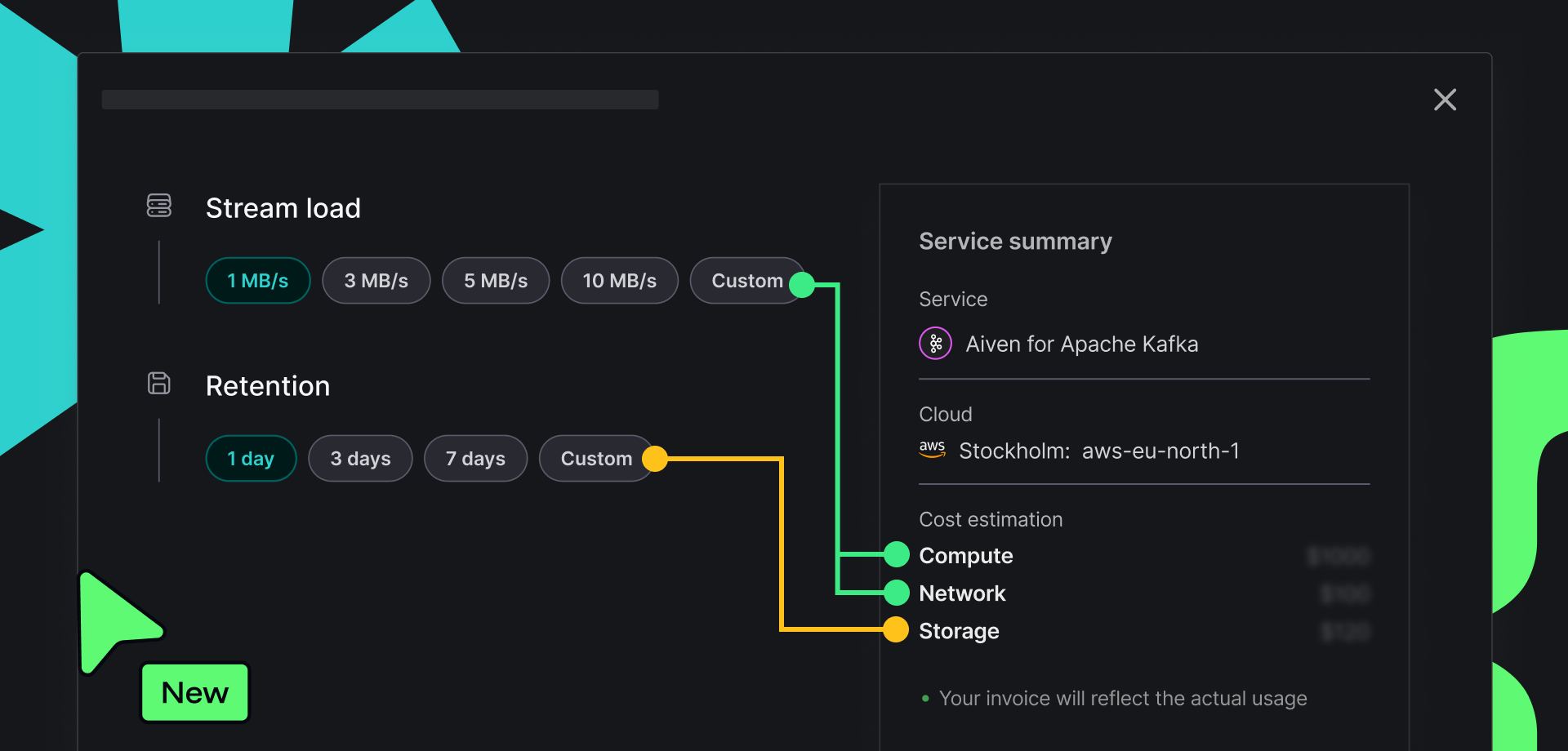
When choosing your cluster you are guided by three things:
- Throughput: MB/s of ingress, from near-zero up to hundreds of MB/s+
- Retention: how many days of data you keep
- Topic type: classic topics, or diskless topics for high-throughput workloads
And you pay for three things:
| Line | Rate | What it covers |
|---|---|---|
| Compute | $ per hour, from $235/month | The scale of the cluster, sized by your throughput |
| Storage | from $0.10 per GB-month | Total data in object storage, priced by what you retain. That's how much, for how long |
| Network | Classic topics: $0.02 in / $0.04 out per GB, Diskless topics: $0.01 in / $0.03 out per GB | Data you actually produce and consume |
What this means for you
For our existing customers: nothing changes. Your plans, prices and contracts stay exactly as they are. The above only apply to new services, but do talk to your sales representative if you have questions.
New customers see the new model in the console today. Create a service, pick your throughput and retention, and the price is on the screen.
Existing customers stay on their current plans and prices, full stop. We will not migrate you, and we will not quietly change your bill. If the new model looks better for your workload, talk to your account team and we will run the numbers with you, including the cases where staying put is cheaper.
Our free plan also remains unchanged as does our dev tier.
Goals for our pricing structure
Our goals are simple:
- Price in the language of streaming: throughput and retention, not CPU cores
- Easy to estimate: make every line on the bill traceable to usage, no bundled estimates and no hidden gotchas
- Reward efficient architecture: workloads that move to diskless topics pay lower network rates, because object storage does the replication work
To get the rates right we asked some fundamental pricing questions: what value does the platform create compared to running Kafka yourself or buying it elsewhere, what does it cost us to serve (for Kafka, network is the real cost), and, as builders ourselves, would we be happy to receive this bill?
Pricing Kafka is hard
For six years we priced Kafka the way the industry prices most infrastructure: by the machine. You picked a plan with a name like business-4, defined by CPU, RAM and disk, and hoped it matched your workload.
Here is the problem: streaming engineers do not think in machines. Builders of streaming services think in MB/s of throughput and days of retention. Nobody wakes up wanting 9 nodes. Certainly nobody wants to reverse-calculate the disk space they need to provision based on those variables. Machine-based plans force every builder to attempt to translate their workload into hardware. Not only is that inconvenient, it's difficult, and people frequently get it wrong.
We spent the past year exploring alternatives. We considered:
- per-partition pricing (it punishes good data design)
- per-message pricing (unauditable at Kafka scale)
- abstract "unit" models (these ended up being opaque: it was too hard to check a unit against a cloud bill)
In February we shipped an interim mode, where network cost was estimated and baked into an inflated compute price. It was simpler, but it made every builder pre-pay for a network we assumed, not the network they used. Whilst offering good value, we weren't satisfied.
Each model failed the same test: you should be able to predict your bill from your architecture. So we did what we always do at Aiven: build it in the open, ship it, and listen.
Why we stopped selling machines
A concrete example. A builder with 1 MB/s in, 3 MB/s out and 3 days of retention used to face a puzzle. Guess startup-4 at $265 and run out of disk. Do the maths properly and you need business-4 plus extra disk: $792 per month, with unnecessary compute idle.
On the new model the same workload costs $620: $235 compute, $25 storage, $360 network. Every line maps to something you can measure, and optimize, against your own metrics. Scale to zero traffic and you pay the $235 floor. Grow to 5 MB/s and the bill grows smoothly with you, not in hard to predict jumps.
Storage works the same way. Data moves to object storage, so retention is a dial, not a disk-size decision. You will never buy a bigger cluster because a topic got popular over time.
Making network pricing predictable
Metered network is the part builders fear, and the fear is earned: the industry has trained everyone to expect shock bills. We designed against that directly.
The rates are flat per GB, published on the pricing page, with no tiers and no surcharge for the replication traffic inside your cluster. The pricing calculator shows your full monthly cost, network included, before you create a service. Ingress and egress usage appear in your service dashboard from day one, so the invoice is never the first place you see a number.
Diskless topics cut the network line further. Because KIP-1150 moves replication into object storage, we charge half the classic ingress rate. On plans from 10 MB/s upward you can mix classic and diskless topics in one cluster and let each workload pick its own economics.
Diskless topics are no longer a separate product or a promo: they are a standard capability of Aiven for Apache Kafka.
Next steps
Price your workload in the calculator, or sign up and create a Kafka service in under 10 minutes. The full model is documented in our docs.
Pricing is something we expect to evolve as we learn. Just as we did with diskless topics, our commitment is to keep increasing the value of the platform while driving the cost down, not the other way around. Our success is measured by the success of the builders who use the platform.
