



TL;DR
- Aiven Managed Agents is a managed runtime for production AI agents. It runs them next to your data, on an open source core, instead of on a developer's laptop.
- One of the most common use cases is the SRE AI agent, which monitors your services and fixes what it is allowed to fix.
- Create an agent from a template, describe it in plain language, or configure the model, instructions and tools manually.
- Agents run durably, keep memory in your own environment, reach databases, APIs and services through MCP, and start on demand, on a schedule, from a webhook or from an event.
- Access control, a secrets vault, audit logs, tracing and cost tracking are built in.
- It works with any model, and your data, execution and API keys stay in your environment, with no vendor lock in.
The problem with agents that live on laptops
Agents multiply quickly once they prove useful. Teams usually run into the following problems, roughly in this order:
- Too many unmanaged agents. Each team builds its own agent in its own way, and nobody has a complete inventory of what is running.
- Rising AI cost. Agents call models and services continuously, and without per agent tracking nobody can say which agent spends what.
- Broad access without an audit trail. An agent with broad credentials can reach production data, and when something goes wrong there is no record of what it did.
- No owner for the runtime. Someone has to run the runtime, scale it, patch it, secure it and monitor it. In practice, nobody was assigned.
- Vendor lock in. An agent built around one vendor's runtime is hard to move when your models, tools or clouds change.
What Aiven Managed Agents is
Aiven Managed Agents is a managed, open source platform for running AI agents as a service. Aiven operates the runtime, scaling, upgrades, security and monitoring. Agents run next to your data stack, so they work with live context instead of stale exports. It is part of the Aiven Data & AI Cloud, which puts your agents, the applications they run in and your data on one managed platform.
In practice, it works like an AI site reliability engineer for your data infrastructure. You ask a question in plain language, the agent inspects the actual state of your services, and it can act on what it finds within the permissions you grant. It builds on the Aiven MCP server, which already lets assistants such as Claude and Cursor manage PostgreSQL, Apache Kafka and application deployments on Aiven. One of the most common use cases we see on the Aiven Managed Agents platform is the SRE AI agent: an always on agent that monitors your services, investigates incidents and fixes what it is allowed to fix, as the examples below show.
How it works
Agents run in a managed runtime next to your data stack. The diagram shows how the components fit together.
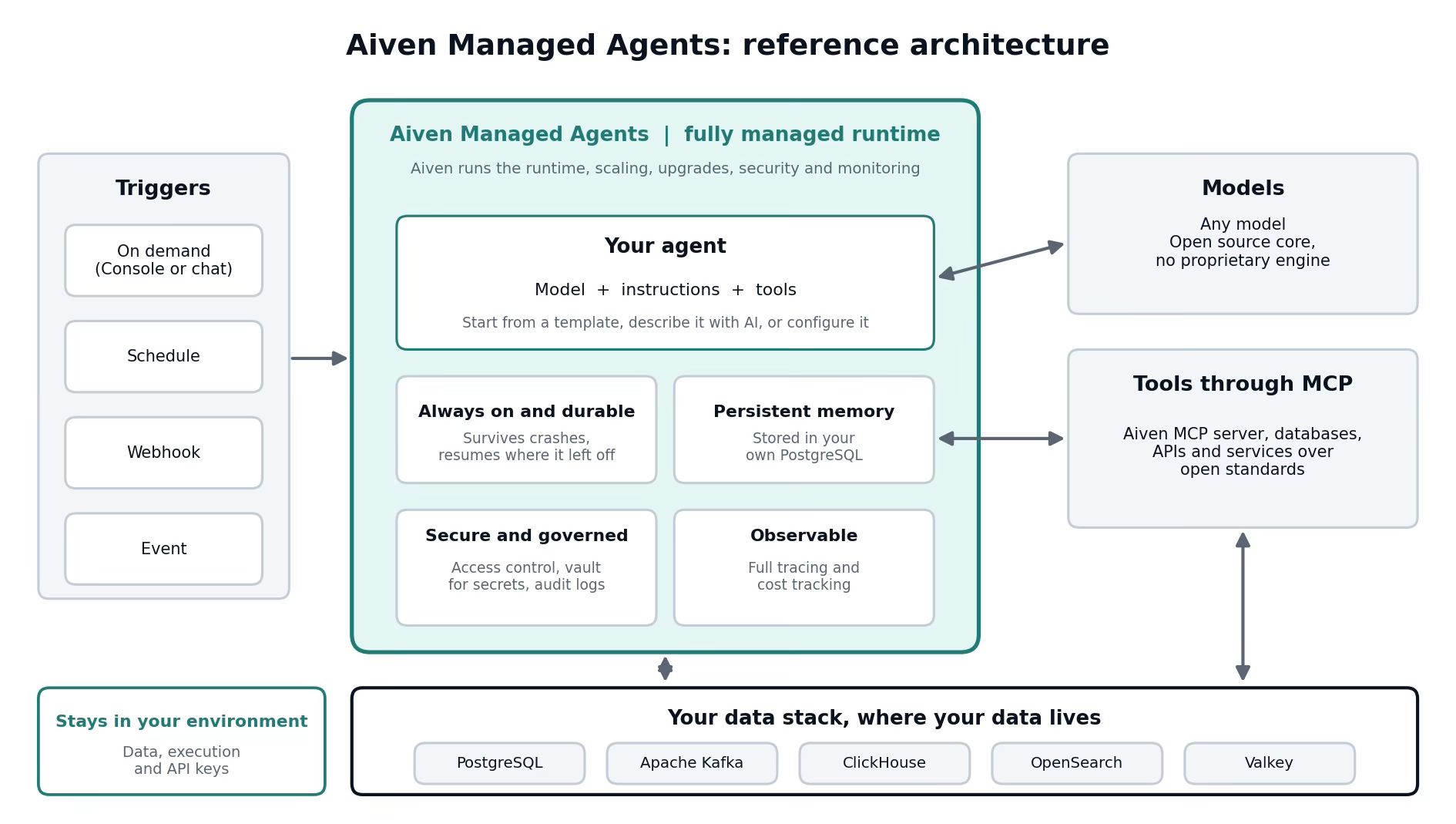
A trigger starts the agent: on demand from the Console or chat, on a schedule, from a webhook or from an event. An agent is a model combined with instructions and tools. The runtime keeps agents running durably, scales to many concurrent agents across distributed workers, and stores their memory in your own PostgreSQL. Tools connect through MCP to your databases, APIs and services, including the Aiven MCP server for PostgreSQL, Apache Kafka, and metrics and logs. Access control, a secrets vault and audit logs govern every action, and tracing and cost tracking make each agent observable. Data, execution and API keys stay in your environment.
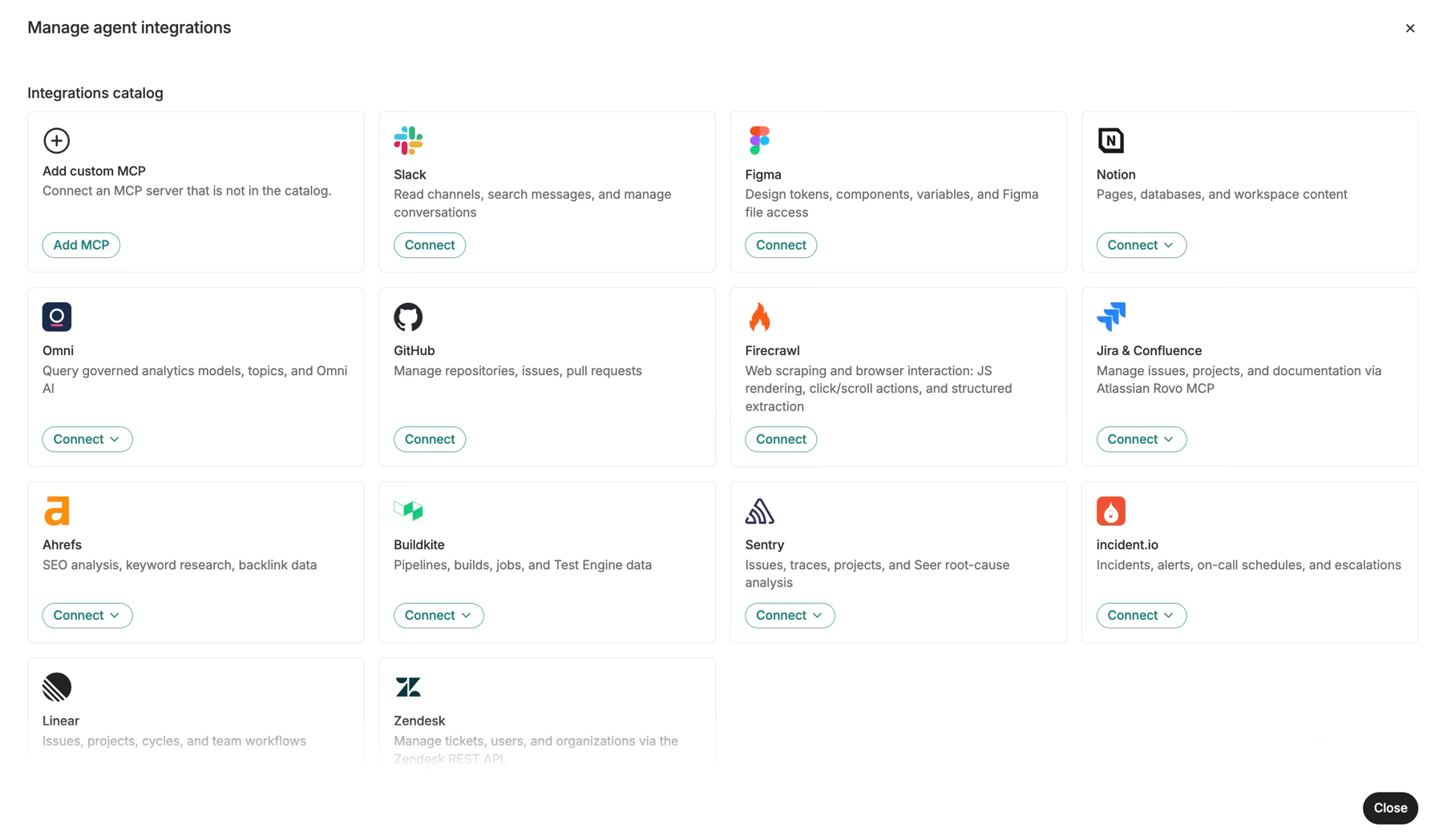
Tools are added from an integrations catalog, shown below. It covers Slack, Figma, Notion, Omni, GitHub, Firecrawl, Jira and Confluence, Ahrefs, Buildkite, Sentry, incident.io, Linear and Zendesk, and any other MCP server can be added as a custom integration.
You can also use the Aiven MCP server on its own from any MCP client, such as Claude, Claude Code, Cursor or VS Code. A prompt goes in and scoped API calls come out, in read only mode, with full access, or with a custom scope that you choose. Managed Agents takes the next step and runs the agent for you.
Create your first agent in three steps
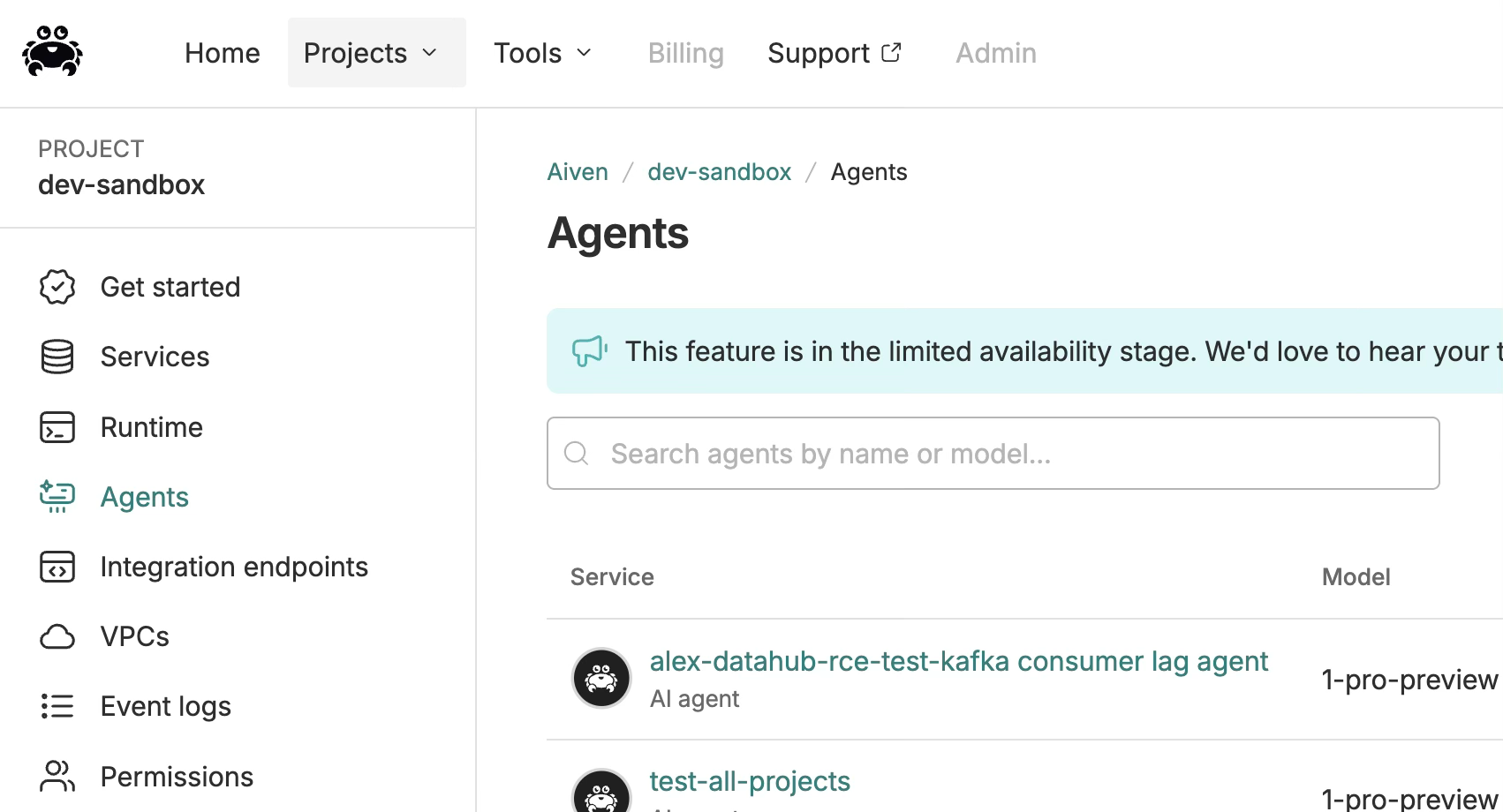
In the Aiven Console, open your project and go to Agents, then choose Create agent. The wizard has three steps. The first one asks how you want to start:
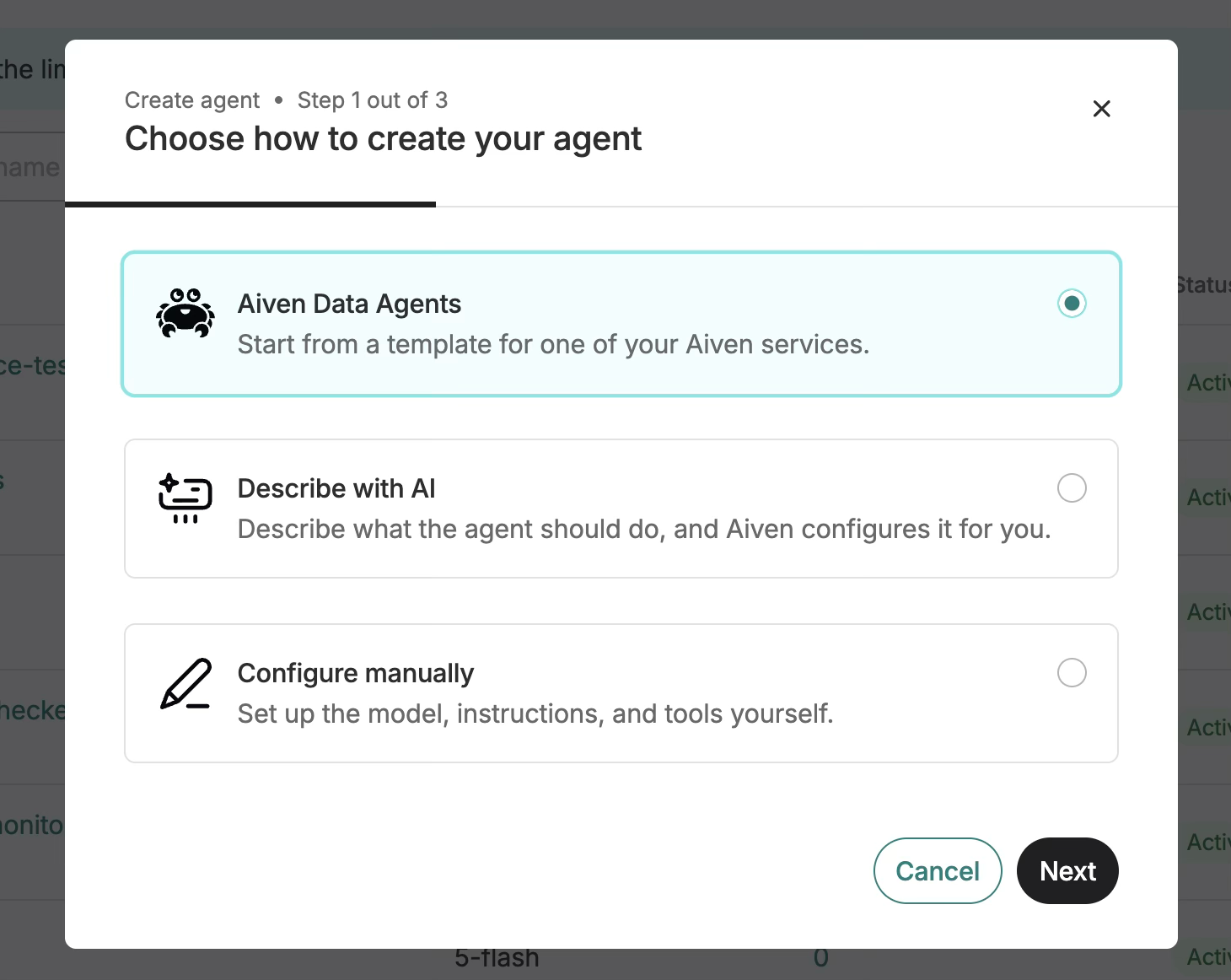
- Aiven Data Agents. Start from a template for one of your Aiven services, such as a database health or Kafka consumer lag agent.
- Describe with AI. Describe the task in plain language and Aiven generates the configuration.
- Configure manually. Choose the model, write the instructions and attach the tools yourself.
Next, connect the services and tools the agent needs, define what it is allowed to access, and choose its trigger: on demand, on a schedule, from a webhook or from an event.
What you get
- Always on and durable. Agents run continuously, survive crashes and resume where they left off.
- Persistent memory. Conversations and context are stored in your own PostgreSQL, so agents keep state across runs.
- Connected through MCP. Connect agents to databases, APIs and services over an open standard instead of custom integrations.
- Secure and governed. Access control, a secrets vault and audit logs show who and what touched your data.
- Observable. Full tracing and cost tracking for every agent.
- Triggered. Start agents on demand, on a schedule, from a webhook or from an event.
- Scalable. Run many agents at once, scaled horizontally across distributed workers.
- Open source core. There is no proprietary engine to depend on.
Why teams choose it
- Simple. Create an agent and connect your services in minutes.
- Fully managed. Aiven runs the runtime, scaling, upgrades, security and monitoring, so nobody on your team has to.
- No lock in. The core is open source and portable, and it works with any model.
- Your data stays yours. Data, execution and API keys stay in your environment.
- Close to your data. Agents run next to your data stack, and live context plus persistent memory improve the quality of their answers.
For Aiven customers, and for everyone else
If you already run services on Aiven, agents start where your data already lives. Templates cover your Aiven services, the Aiven MCP gives agents a structured way to inspect PostgreSQL and Apache Kafka, and the access rules, audit logs and security controls you already use apply to your agents.
If you do not use Aiven for your data yet, the model still holds. Agents reach databases, APIs and services through MCP and open standards, work with any model, and run on an open source core, so you get a managed service without committing to a single vendor. You can start with the agent and decide later how much of the rest of the platform you want.
Teams typically use it in two ways. Internal operations agents automate recurring workflows across business and technical teams, and run continuously inside your own infrastructure. Product embedded agents deliver agent features inside your own product, for your own customers.
See it in action: a slow queries agent
Here is a complete agent built with Aiven Managed Agents. The agent, pg-slow-query-analyzer, receives one request: check for slow queries across my Postgres services and send a summary to Slack. It lists your projects, pulls query statistics from your PostgreSQL services and posts a report to Slack with the number of slow queries per service over the last 24 hours, so the team knows where to look first.
Watch the demo (30 seconds)
Examples: ask the agent
The 3 AM database incident
Your product is slow, customers are writing in, and nobody on the team has cloud engineering experience. Instead of searching for a runbook, you ask the agent: is our database healthy? It checks the service status, logs and metrics, explains in plain language what is wrong, and fixes what you have allowed it to fix. A team with nobody to call gets an on call engineer that is always awake.
The vacation
Every team has the engineer who can never fully disconnect, because only she knows how to fix the database. When it slows down in the middle of her vacation, she asks the agent to fix it, and the agent does. Better still, she schedules the agent to check the database regularly, so most problems are handled before anyone has to ask.
E-commerce toy store UK launch: Kafka in London
Santa has three days to launch an online toy store in the UK, and the store needs data streaming close to its new customers in London. Nobody has time to build a cross region setup by hand, so an engineer asks the agent to do it. The agent replicates the Kafka data to London, and the streaming service is live in time for the launch.
Create your first agent now
Managed Agents is currently in limited availability. Request access through the Aiven Managed Agents page, then open the Aiven Console, go to Agents and create your first agent for one of your services. If you are new to Aiven, create an account and start with a service you already know.
Your agents, your data, fully managed on Aiven. Create your first agent today.

Table of contents